

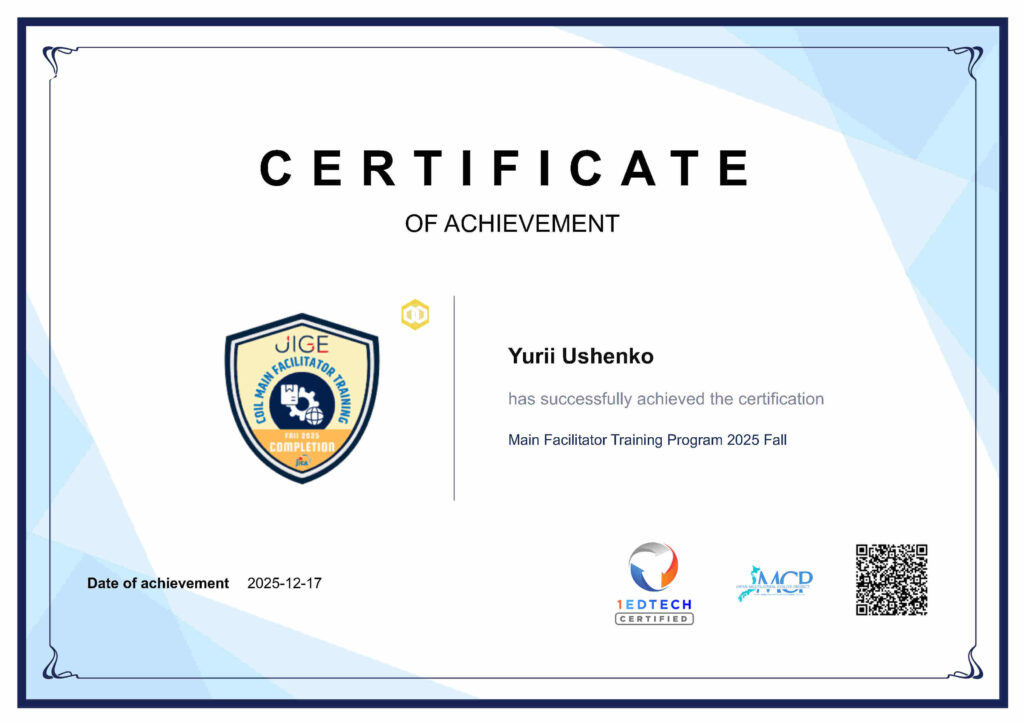
Professor Yurii Usenko, Head of the Department of Computer Science at Yurii Fedkovych Chernivtsi National University, took part in international online events as part of the JICA initiative to introduce project-based learning (PBL) and collaborative online international learning (COIL) in the training of IT specialists.
The training programme was announced as one that will be implemented in 2025 with the support of JICA and the recognition/support of the Ministry of Education and Science of Ukraine. and aimed at mastering modern approaches to project-based learning and international online cooperation, as well as developing innovative additional programmes at universities and strengthening the contribution of IT education to the reconstruction of Ukraine.
The content and structure of the training are focused on a practical approach: participants not only learn about PBL/COIL concepts, but also prepare their own pilot programme (module) for students with further support from international experts. This meets the current needs of Ukrainian universities to update educational components, develop partnerships and build bridges with international academic and industrial practices.
The programme materials clearly state that participants will receive:
- certificate of completion;
- practical skills in implementing PBL/COIL;
- opportunity to develop a pilot programme for students;
- mentoring support from international experts;
- experience of cooperation with Japanese universities and the Polish-Japanese Academy of Information Technology.
For the Department of Computer Science, such participation is important in view of the strategic tasks of modernising education: combining fundamental training with team project activities, developing intercultural communication and working with students in international online teams, which is standard practice in the modern IT environment.

Key programme events: from the introductory seminar to the development of the pilot module
The programme consisted of two main stages: introductory activities and practical training, followed by support for the implementation of the developed solutions.
The introductory PBL/COIL seminar took place on 30 October 2025. The schedule includes:
- opening and introduction to the training;
- ‘Introduction to COIL’ section with an explanation of the definition of COIL, benefits for students and teachers, typical problems and challenges, necessary skills and preparation;
- ‘Introduction to PBL’ section with a similar focus on definition, benefits, risks/challenges and organisational requirements;
- group discussions on what social, economic and business problems can be solved by IT means through PBL/COIL in the context of Ukraine’s reconstruction;
- group presentations and discussions on potential barriers to the implementation of PBL/COIL in their universities.
The practical COIL & PBL training block was scheduled for 6, 12, 13, 17 and 21 November. During these sessions, participants worked through the following topics:
- COIL principles, designing effective COIL projects, technologies and tools;
- facilitation, assessment and monitoring, as well as the use of updated tools (COIL toolkit) with independent work (on-demand);
- the application of PBL in Japanese universities (in particular in terms of leadership development, teamwork and adaptation to different contexts);
- criteria for developing a PBL course and practical course development for specific conditions with mutual feedback;
- preparation of an action plan and presentation (development of a pilot PBL/COIL programme) with expert comments; a shared Padlet space is also provided for preparing and submitting materials.
Expert community and international partners
The training was conducted online in English (except for some group discussions), using the Zoom platform’s communication tools; the materials also indicate that the training was recorded.
Among the speakers and organisations involved in the programme are:
- Japan Development Service (JDS) (in particular, admission and coordination support within the programme events);
- Kansai University (COIL block);
- innovst (PBL block);
- representatives of the Polish-Japanese Academy of Information Technology (PJAIT), who participated in discussions and provided feedback.
A separate element of the programme is the opportunity to view PBL classes at Shibaura Institute of Technology (on-demand) between 6 and 30 November, which creates conditions for ‘observing practice’ and transferring the pedagogical solutions seen into one’s own context.
Next steps: support for implementation and piloting in universities
After completing the training, participants will receive follow-up support for designing pilot PBL/COIL modules at their universities as extracurricular activities with the prospect of implementation in the next phase of the JICA initiative. Support includes:
- mentoring from PBL/COIL experts to refine the module design;
- assistance with activity planning and cultural integration;
- addressing risks and potential difficulties (language barriers, technological limitations, etc.).
This block is key to the programme’s real impact on educational practice: it takes learning from the “familiarisation” level to the “developed – tested – refined” level. For the Department of Computer Science at Chernivtsi National University, this opens up opportunities to create modules where students will work on applied tasks (data, cybersecurity, decision support systems, software engineering, data engineering, etc.) in international teams, with transparent assessment criteria, facilitation, and progress monitoring tools.
Significance for Yuriy Fedkovych Chernivtsi National University and the development of IT education
Professor Yuriy Uschenko’s participation in JICA PBL/COIL events serves as a practical step towards:
- strengthening the project component in the training of IT specialists (from setting the task to defending the results);
- internationalisation of learning ‘at home’ through COIL tools;
- development of partnerships with international universities and expert communities;
- creating the conditions for pilot modules that can be offered to students as modern extracurricular practices with high applied value.
As a result, the involvement of the Department of Computer Science at Chernivtsi National University in such initiatives creates added value both for students (teamwork, international communication, real-life case studies) and for the university as a whole (updating educational approaches, scaling up best practices, expanding the network of academic contacts).


